Support for more complex needs - dementia and Alzheimer's, developmental disabilities, behavioral support, and care during recovery or chronic illness.
Some situations need more than a willing pair of hands. Dementia changes how a person experiences the world, so an approach that worked on Tuesday may not work on Thursday. A developmental disability calls for consistency and for understanding an individual's own way of communicating. Recovery after surgery carries its own risks and its own timeline.
Specialized care is our term for support delivered by caregivers with additional training for these situations, working alongside the family and the person's healthcare providers rather than in isolation. The care plan records what helps, what tends to trigger distress, and what to do when something changes - so the response does not depend on which caregiver happens to be on shift.
Where a task requires a licensed nurse, it is covered through our waiver nursing service rather than by a caregiver. See additional programs and services.
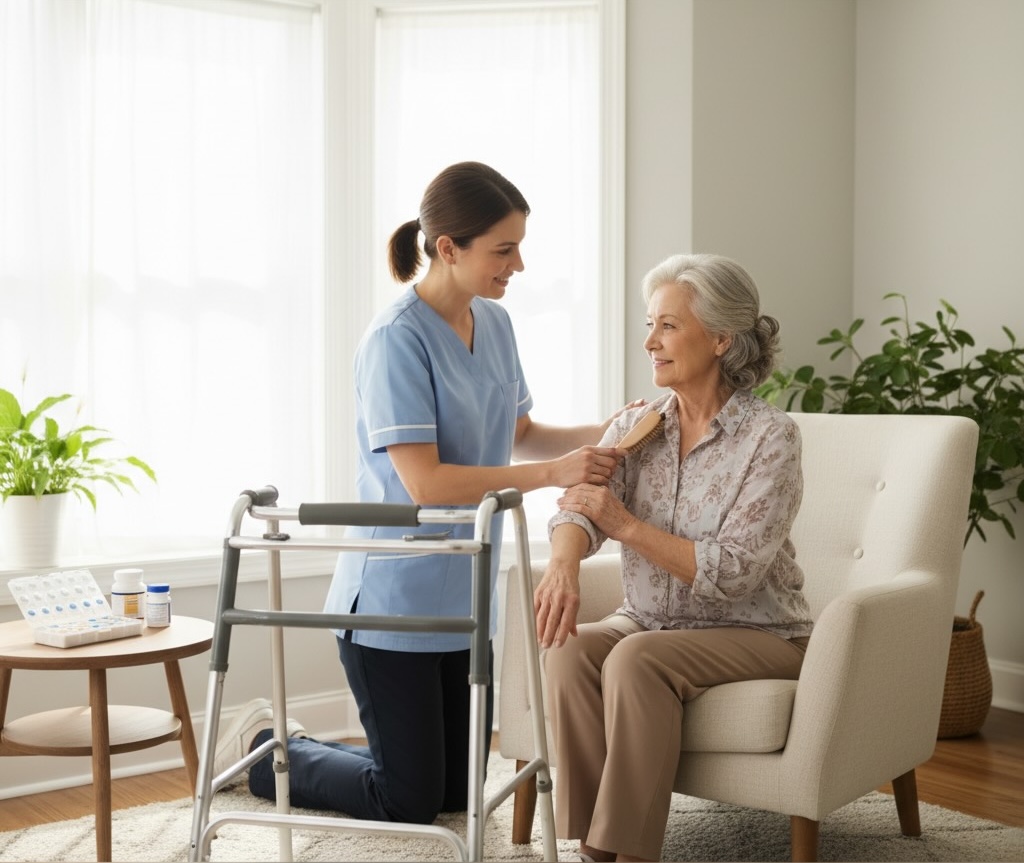
Support built around familiar routines and cues, with caregivers trained to respond to confusion, repetition and distress without arguing or correcting - and to adapt as the condition changes.
Consistent approaches agreed in advance for behaviour that is difficult to manage, so every caregiver responds the same way instead of improvising in the moment.
Supervision through the weeks after surgery or a hospital stay: mobility, personal care, medication timings, and watching for signs that recovery is not going to plan.
Day-to-day support for adults with developmental disabilities, built around the individual's own communication, routine and level of independence.
Keeping the practical side of a long-term condition on track, and keeping the family and everyone involved in someone's care informed when things change.
Comfort-focused support at home alongside the clinical team, for the person and for the family around them.
Specialized care is usually arranged when a diagnosis or an event has changed what the household can manage alone. It often applies when:
Most of it is non-medical support delivered by caregivers with additional training for the situation. Anything that requires a licensed nurse is provided through our waiver nursing service instead. If you are not sure which side of that line a task falls on, ask us and we will tell you plainly.
All Lifeway Cares caregivers take part in ongoing training programs, and caregivers assigned to specialized cases receive training relevant to the condition they are supporting. Ask us about the specific background of the caregiver proposed for your situation - it is a fair question and we will answer it.
Yes. Dementia support is delivered in the person's own home, which is usually where they are most oriented and least distressed. The care plan records routines, familiar cues and known triggers, so the approach stays consistent between caregivers and adapts as the condition changes.
Yes. Working alongside families and healthcare providers is part of how specialized care is planned. Tell us who is involved and what they have advised, and we will build the care plan around it rather than beside it.
Care plans are reviewed as circumstances change, and we will tell you if we believe a situation has moved beyond what home care can safely cover. That is a conversation we would rather have early than late.
Yes. Lifeway Cares is a state licensed healthcare agency. Our caregivers are background-checked and receive ongoing training, and the agency is bonded and insured, with HIPAA compliant practices and 24/7 support availability.
Contact us for a free consultation. We'll help you understand your options and create a personalized care plan.